Ink
The interesting conclusion is that 60 is not a particularly problematic age for a first tattoo. The bigger issue is skin condition, placement, design geometry, and artist experience with mature skin. A 2025 medically reviewed article specifically addressing tattoos in older adults makes the same point.
For a man in his 60s, I’d favor:
1. Medium-sized rather than tiny
2. Bold, clean linework rather than ultra-fine-line detail
3. Black, black-and-gray, or restrained color
4. A design with some personal meaning rather than a generic “manly” tattoo
5. Forearm, upper arm, shoulder, or outer arm rather than hand, wrist, neck, chest or lower leg
6. A design that will still look intentional if the lines soften somewhat over 10–20 years
The reason is straightforward: aging skin becomes thinner, drier, less elastic and heals more slowly.
Very fine lines and extremely intricate details therefore give you less margin for the inevitable changes in the tattoo and the skin around it.
Interestingly, tattoo artists and people discussing first tattoos at 60+ repeatedly make the same observation: slightly larger, bolder designs generally age better.
The American Academy of Dermatology also recommends choosing tattooed skin away from moles, because ink can make it harder to notice early changes that could indicate skin cancer.
Placement may matter more than the design
For your first tattoo, I’d put the shortlist at:
1. Outer forearm — probably my #1 choice
It has several advantages:
relatively accessible and easy to care for
you can see it yourself
generally less painful than many bony locations
enough relatively flat real estate for a meaningful design
can be covered by a long-sleeve shirt
tends to work well for medium-sized designs
Older-adult tattoo guidance specifically identifies the forearm, upper arm, outer arm, shoulder and some areas of the back as relatively comfortable locations.
2. Upper outer arm
Probably the safest choice if you’re unsure about visibility.
A 3–5 inch design can look intentional without announcing “I just got my first tattoo.”
3. Shoulder / upper shoulder
Excellent for something more substantial.
It also gives the artist more freedom to create a composition that follows the body’s shape.
4. Inner forearm
More visible and potentially more personally expressive.
I’d choose this if the tattoo is something you actually want to look at frequently.
One particularly important consideration at 60
I’d have the artist look at your skin before you decide on the exact design.
This is more important than simply asking:
“Do you tattoo older people?”
Ask:
“Can you show me several healed tattoos you’ve done on people in their 60s or 70s, preferably at least 2–5 years old?”
That’s a much better test.
A tattooer’s Instagram portfolio largely shows fresh tattoos. You want to see what their work looks like after healing and aging.
I’d also tell the artist:
“This is my first tattoo, and I’m looking for something that will look good at 60, but also still look good when I’m 75 or 80.”
A good artist should immediately start thinking about line weight, negative space, placement, skin laxity, scale and aging.
Black & gray versus color
For you, I would initially lean black and gray.
Not because older men shouldn’t have color—quite the contrary—but because:
black has excellent long-term contrast
gray shading can create considerable depth
it doesn’t depend on maintaining highly saturated colors
it looks sophisticated with casual or formal clothing
it works particularly well with natural, Japanese, illustrative and geometric subjects
The AAD emphasizes that UV exposure fades tattoo ink and recommends SPF 30+ on healed tattooed skin.
“What should a man getting his first tattoo at 60 want to say about himself?”
That’s where I think you could get something much more interesting than a generic compass, mountain, lion, skull, anchor, etc.
Given that this is your first tattoo, I’d consider four broad directions:
A. A symbol of a life transition
Retirement / beginning of a new chapter / freedom / exploration / reinvention.
This could be extremely subtle.
B. Something connected to family
Not necessarily names or dates.
A symbol representing your family can be much more timeless.
C. Something connected to your creative life
You have interests in art, music, woodworking, pottery, bonsai and Japanese aesthetics. That opens up a far more interesting design vocabulary than stereotypical men’s tattoos.
For example, a tattoo could incorporate:
a bonsai branch
a particular tree species
a Japanese botanical form
a pottery mark
a musical motif
an abstract wood grain
a tool or object associated with making things
an imperfect/aged natural form
D. Something that represents how you want to live the next 30 years
This is perhaps my favorite category.
Rather than commemorating the first 60 years, the tattoo could represent the next chapter.
That could lead to something remarkably personal without being obvious to anyone else.
One final medical consideration
Before getting tattooed, particularly at 60+, it’s worth discussing it with your physician if you have conditions or take medications that could affect bleeding, infection or wound healing. Blood thinners are specifically mentioned as a consideration for older adults.
ChatGPT selected 15 concepts for you
1. The Evolving Bonsai —
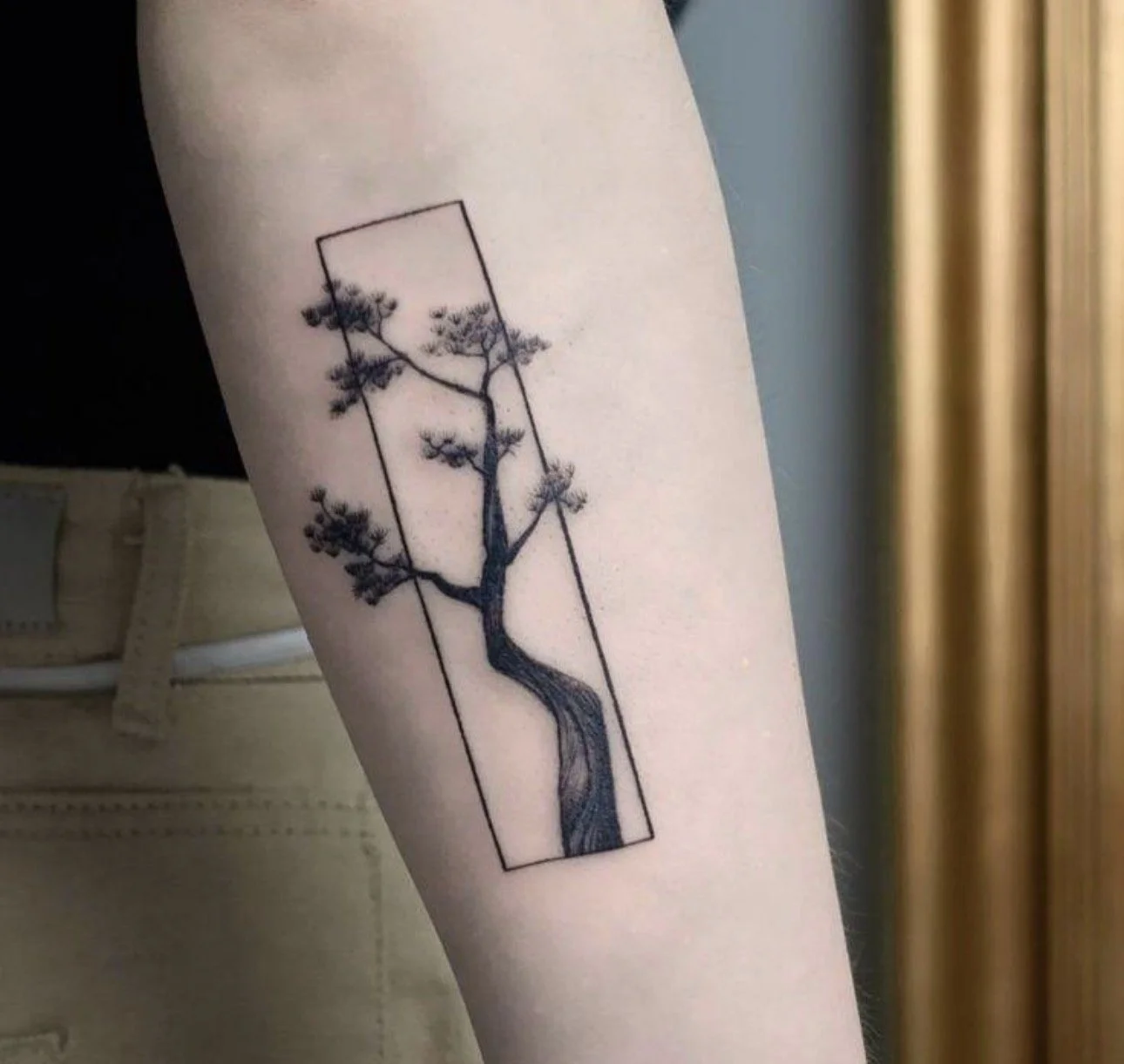
2. The Unfinished Circle —Ensō
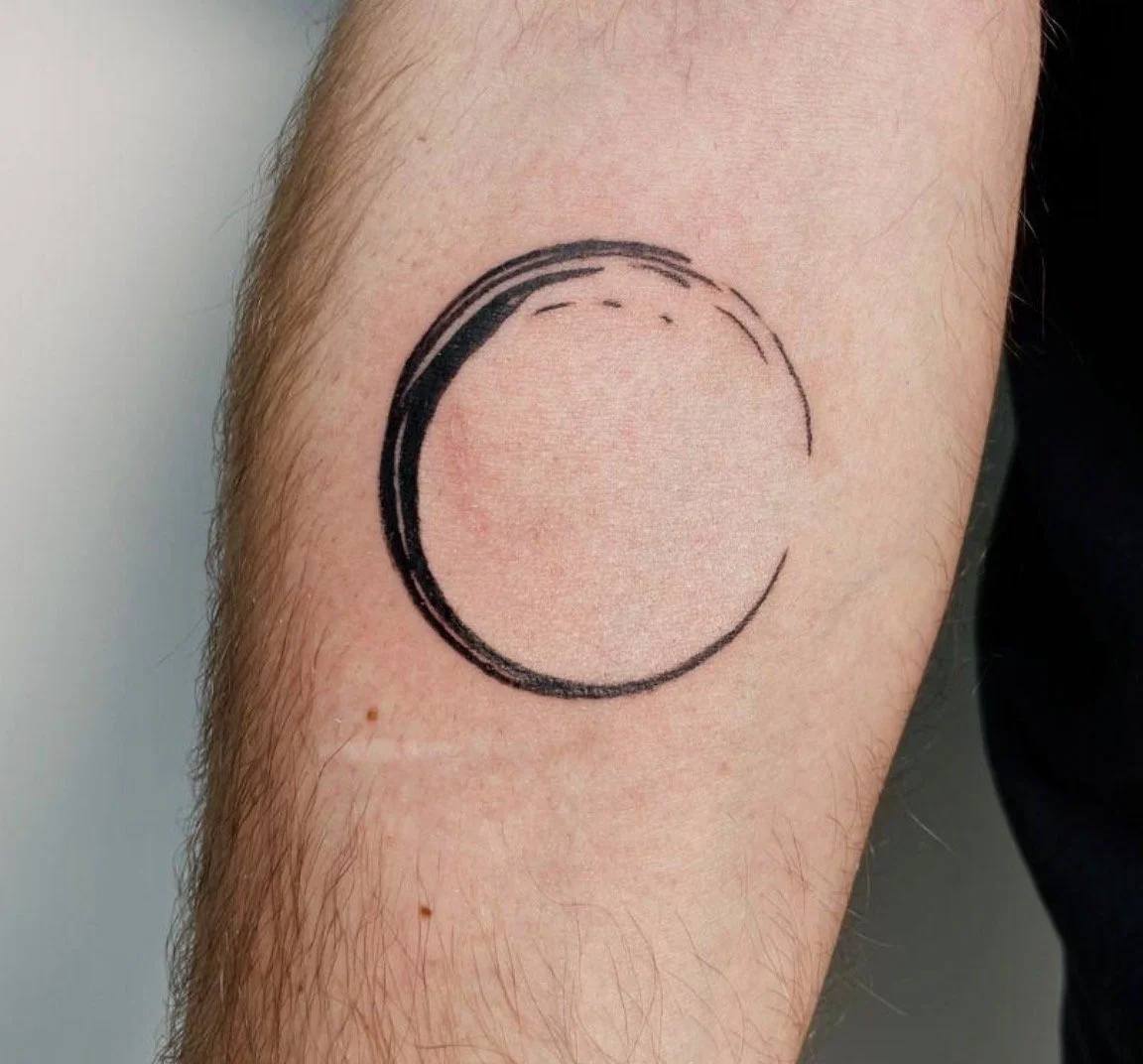
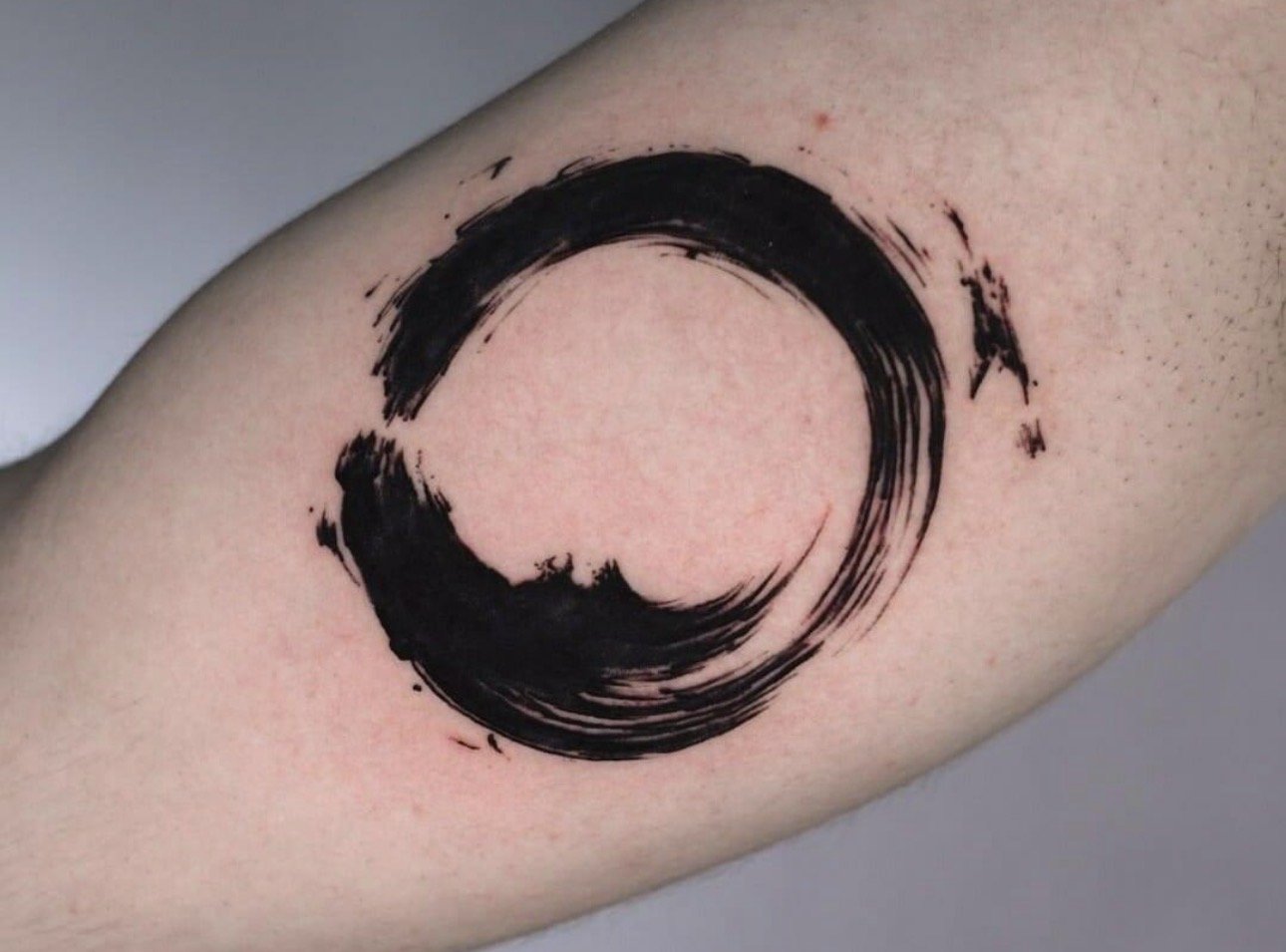
An Ensō—the imperfect Japanese circle—could be extremely powerful for a first tattoo.
It represents imperfection, completion, openness and the ongoing nature of existence.
Placement: outer upper arm or upper forearm.
Artist direction:
“I want this to look like a single confident brushstroke—not a geometric circle. Preserve the irregularity and texture of a real brush.”
Risk: It is a fairly common tattoo concept. The execution has to make it yours.
3. One Branch / One Life
This is a more sophisticated variation of #1.
Instead of a whole tree, imagine one old branch emerging from negative space, with perhaps one small new shoot.
The visual metaphor is:
old wood → new growth
That makes it particularly appropriate for your transition into retirement.
Placement: inner or outer forearm.
Size: 4–5”.
Style: Japanese sumi-e-inspired black/gray, but designed as a tattoo rather than a painting.
The aesthetic I’d recommend
I wouldn’t actually tell the tattoo artist:
“I want a bonsai tattoo.”
I’d say:
“I want a small Japanese-influenced black-and-gray illustrative tattoo inspired by an old Japanese black pine. I want it to feel like an ink drawing rather than a conventional tattoo. Use strong organic linework, deliberate negative space, limited shading and no unnecessary detail. It needs to remain legible as the skin ages.”