Medicare at 65
Medicare Explained
Medicare Part A: your income doesn’t normally matter
If you have the required work history—which you almost certainly do after a long career—Part A is premium-free. In 2026, about 99% of Medicare beneficiaries don’t pay a Part A premium.
Importantly, there is no Part A IRMAA. Your retirement income doesn’t cause your Part A premium to increase.
Part B: this is where your income matters
This is the big one for your retirement tax planning.
Medicare Part B has a standard premium, which is $202.90/month in 2026, but higher-income beneficiaries pay IRMAA.
For a married couple filing jointly, the 2026 thresholds are:
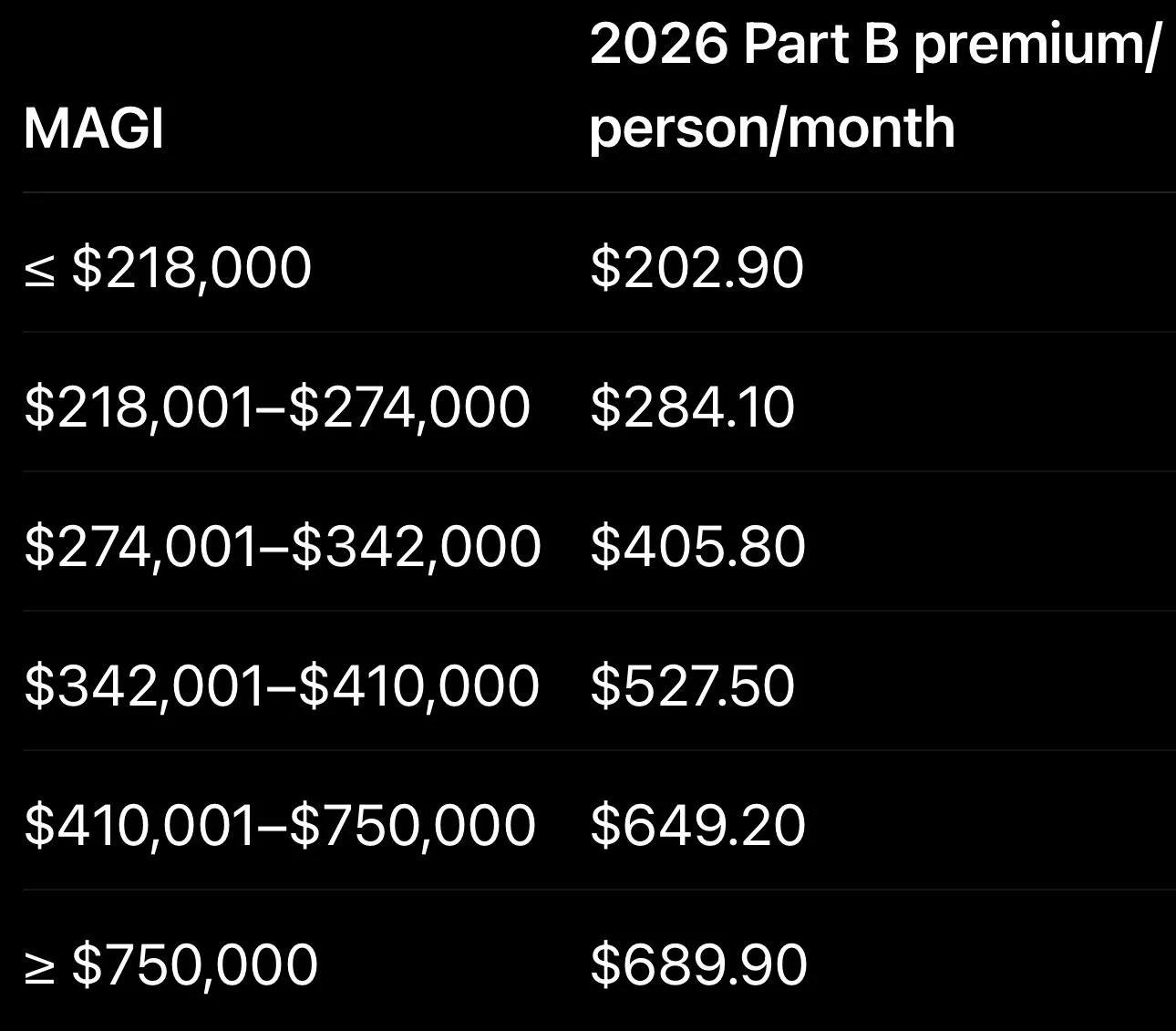
And Part D has its own IRMAA, even though your prescription coverage may be incorporated into the employer-sponsored Medicare Advantage plan.
The important point for your retirement planning is that IRMAA is based on MAGI, not simply “taxable income.” Medicare generally uses your tax return from two years earlier to determine IRMAA.
Medicare Advantage: this is different from ACA
This is where I think your understanding can be sharpened.
A Medicare Advantage plan is not priced like an ACA Marketplace plan.
Medicare Advantage plans generally don’t say:
“Your income is $180,000, so your premium is $X; your neighbor makes $60,000, so theirs is $Y.”
Instead, you pay the plan’s established premium (which may be $0, low, or higher), plus your applicable Part B premium. Medicare explicitly says that you must have Part B and continue paying its premium to remain in Medicare Advantage.